
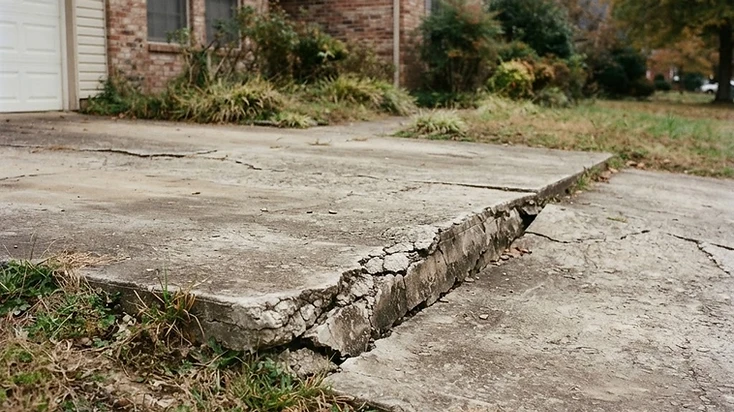
Concrete is rigid. Soil isn't.
A concrete slab doesn't compress or shrink. If it has dropped, it's because the soil under it moved. That's the entire principle behind why lifting works.
What causes the soil to move
Erosion. Water gets under the slab through a joint or an edge, washes fine soil particles away, and leaves a void. The slab settles into the gap.
Clay shrinkage. In a dry summer, expansive clay shrinks. The slab loses support and drops.
Poor compaction. A slab poured over fill that wasn't compacted properly will settle as the fill consolidates. This is common on newer construction.
Drainage failures. A downspout dumping onto a driveway, or a grade that sends water under the slab, accelerates all of the above.
Signs it's more than cosmetic
- A visible lip or trip hazard where slabs meet
- Water pooling against the house or running into the garage
- Slabs pulling away from the foundation
- Cracks that are getting wider or have vertical displacement
- A settled apron at a garage door
Why lifting usually wins
Replacing a slab means breaking it out, hauling it away, compacting and regrading the base, pouring new concrete, waiting for it to cure, and redoing whatever landscaping you disturbed.
Lifting and stabilizing uses the slab you already have. It's typically done in a day, and you can usually drive on it the same day.
When replacement is the right call
If the concrete itself is badly deteriorated — crumbling, spalling, or broken into pieces — lifting won't help, because there's nothing sound to lift. In that case, replacement is the honest answer.
The thing to fix afterward
Whatever caused the soil to move is still there. If water is still flowing under the slab, the settlement will come back. Managing drainage is part of the repair, not an upsell.

