
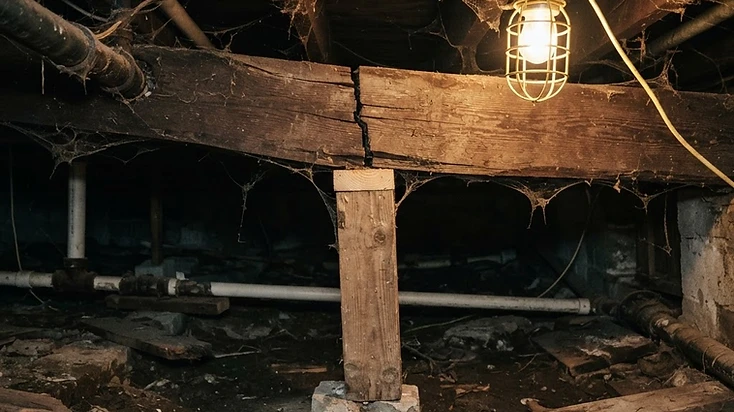
Start with where the dip is
Where the floor is uneven tells you a lot about why.
A slope toward one wall or corner
Usually means the foundation or the supporting piers on that side have settled. This is the pattern most likely to be foundation-related.
A dip in the middle of a room
Usually means the floor joists or the beam under them are sagging or have failed. That's a framing problem more often than a foundation one.
A bounce rather than a dip
Springy floors often mean the joists are undersized for the span, or that a support post has moved. Sometimes it's just how the house was built.
The usual suspects
Rotted joists. In Middle Tennessee, this is the big one. A vented crawl space stays humid, wood stays damp, and rot starts at the bearing ends where the joist sits on the beam or foundation. This is why I always want to see under the house.
Failed or missing supports. Older homes often had a pier or post removed during a plumbing repair, or a post that's been shimmed repeatedly until it's no longer doing its job.
Settled piers or footings. The ground under a pier moves, the pier drops, and everything above it drops with it.
Undersized beams. A beam that was never engineered for the span will sag over time, no matter how well it was built.
How bad is it?
A useful way to think about it: floors move slowly. A dip that took twenty years to develop isn't an emergency, but it also isn't going to fix itself, and it usually gets more expensive to address the longer it's left.
What would make me move quickly:
- A floor that feels soft or spongy underfoot — that's rot, and rot spreads
- A dip that has developed in the last year or two
- Bouncy floors plus a musty smell
- Any floor movement along with a crack that's getting wider
What I'd check first
I want to see under the house. A photo of the crawl space showing the joists, the beam and the posts tells me more in ten seconds than a description can in ten minutes.
From there it's usually straightforward: replace what's failed, add support where it's missing, and fix whatever caused the failure in the first place.

