
The clay is the whole story
Middle Tennessee sits on expansive clay soils. That means two things at once: clay drains very slowly, and it changes volume dramatically as it gets wet and dry.
For a basement, that's a difficult combination. Water that falls near your foundation doesn't drain away quickly. It soaks into the clay, the clay swells, and the saturated soil pushes against your basement wall with real force.
That's hydrostatic pressure, and no coating applied on the inside will stop it.
How water actually gets in
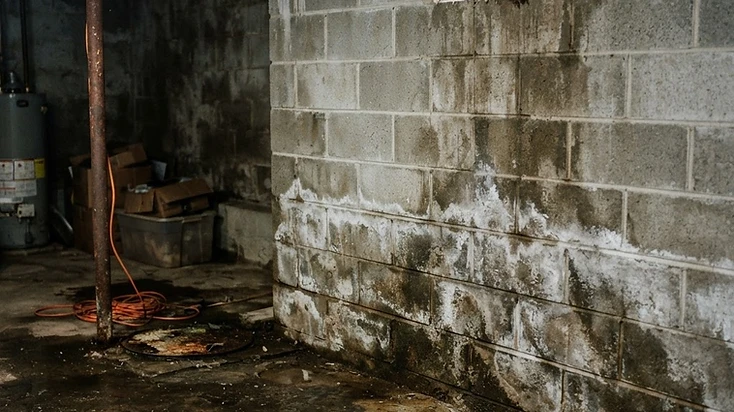
- Through the wall. Concrete block is porous. Water moves through it and evaporates inside, leaving the white powdery residue called efflorescence.
- Through the floor joint. The seam where the wall meets the floor is a classic entry point.
- Through cracks. Horizontal cracks in a block wall usually mean lateral pressure.
- Over the top of the wall. If the grade outside is at or above the top of the foundation, water runs over the wall and down inside.
What the white powder means
Efflorescence is mineral salts deposited when water passes through masonry and evaporates. It's not harmful by itself, but it's diagnostic: if you have efflorescence, water is moving through that wall.
If you scrub it off and it comes back, the water is still coming.
Fix it from the outside in
In order of how much they matter:
- Downspouts. Extend them well away from the house. This is free and fixes more basements than anything else.
- Grade. The soil around the house should slope away at roughly a six-inch drop over the first ten feet.
- Surface drainage. Swales or French drains to move water around the house, not through it.
- Interior drainage and a sump. A channel along the inside of the footing that collects water and pumps it out. Reliable, and it works regardless of what happens outside.
- Crack injection and sealing. For specific leaks rather than general dampness.
What to be skeptical of
Any contractor who promises that an interior coating alone will stop water from getting in is either misinformed or hoping you won't call them back. Coatings manage the appearance of dampness. They don't address pressure.

